

AI for Managers: From Strategy to Execution
You're holding someone else's AI decision: a mandate from above, a tool the company just licensed, or just the sense that your team is falling behind. You don't need more strategy talk. You need to know what to actually do with the team you run this month.
The guidance out there splits two ways: boardroom strategy that skips the how, or generic AI hype that never touches your actual job. This course closes that gap. It gives you a short list of tasks worth piloting, a clear map of what stays human and what goes to AI and why, a straight answer for your team's "is this going to replace me," and a 30/60/90-day pilot plan you can run without waiting for permission.
Who it's for
Front-line and mid-level managers, team leads, and department heads at mid-market companies: the people accountable for turning an AI decision into day-to-day team practice, not the ones setting company strategy. If you run a team, assign the work, and answer for how it gets done, this is built for you. You don't need a technical background. Everything is taught in plain, practical language, because the goal is judgment, not code. There is no coding and no model math.
-
-
Intro — The Manager's AI Job
Setting direction and running it are two different jobs. Leaders decide where to point AI. You make it real, on your team, with real people, this month. That's the job this course is built for.
Setting direction and running it are two different jobs. Leaders decide where to point AI. You make it real, on your team, with real people, this month. That's the job this course is built for.
-
-
-
Module 1 — Understand
Forget the alphabet soup. As a manager, there are two kinds of AI you need to tell apart: generative and agentic. Almost everything that shows up on your team, whether your company rolled it out or someone just started using it, is one, the other, or a mix of both. Get that straight and the rest of this course clicks into place.
Forget the alphabet soup. As a manager, there are two kinds of AI you need to tell apart: generative and agentic. Almost everything that shows up on your team, whether your company rolled it out or someone just started using it, is one, the other, or a mix of both. Get that straight and the rest of this course clicks into place.
-
-
-
Module 2 — Find Value
Good news if your company has already been through AI for Leaders: you're not writing governance from scratch. Your job is applying it, on your team, every week. Same six categories your leadership learned, because you both need to be checking the same list.
Good news if your company has already been through AI for Leaders: you're not writing governance from scratch. Your job is applying it, on your team, every week. Same six categories your leadership learned, because you both need to be checking the same list.
-
-
-
Module 3 — Govern
Good news if your company has already been through AI for Leaders: you're not writing governance from scratch. Your job is applying it, on your team, every week. Same six categories your leadership learned, because you both need to be checking the same list.
Good news if your company has already been through AI for Leaders: you're not writing governance from scratch. Your job is applying it, on your team, every week. Same six categories your leadership learned, because you both need to be checking the same list.
-
-
-
Module 4 — Workforce
This is the part of the job that's actually hardest, and the reason you're the one taking this course and not just your leadership: managing a team that's part human, part AI, including the conversation that comes with it. I'm not going to hand you a script to make that feeling go away. I'm going to give you something better: a clear, honest way to think about it, and the words to say what's actually true.
This is the part of the job that's actually hardest, and the reason you're the one taking this course and not just your leadership: managing a team that's part human, part AI, including the conversation that comes with it. I'm not going to hand you a script to make that feeling go away. I'm going to give you something better: a clear, honest way to think about it, and the words to say what's actually true.
-
-
-
Module 5 — Act
You're not starting this module from a blank page. Your glossary sharpened how you talk about this. Your task audit gave you three real candidates. Your governance checklist gave you guardrails. Your role map gave you a clear human-versus-AI split. This module doesn't ask for new analysis. It asks you to sequence what you already have into something you run this quarter.
You're not starting this module from a blank page. Your glossary sharpened how you talk about this. Your task audit gave you three real candidates. Your governance checklist gave you guardrails. Your role map gave you a clear human-versus-AI split. This module doesn't ask for new analysis. It asks you to sequence what you already have into something you run this quarter.
-
What You’ll be able to do
By the end of the course you will be able to:
Talk about AI, generative and agentic, accurately with your team, and use the vocabulary that keeps you from getting sold by a vendor pitch
Score your team's real, recurring tasks for AI-fit and walk away with three specific candidates worth piloting in the next 30 days
Apply your company's AI guardrails at the team level, and know what's your call versus what needs to go up
Use a clear human + AI strengths map to redesign roles and delegate to an agent the way you'd delegate to a person
Give your team a straight, honest answer on "is this going to replace me," grounded in facts instead of a script
Build and run a 30/60/90-day team AI pilot plan, with a metric your own leadership will recognize

What's inside
Five core modules and a short intro, a few hours of focused, self-paced learning. Each module pairs a clear explanation with a working template you complete using your own team.
Intro: The manager's AI job. Why this is a different job than the leader's: leaders decide where to point AI, you make it real on your team. The two ways managers get this wrong, waiting for a perfect plan or letting the team freelance with no shared practice, and what you'll walk away with. This is not a technical course. It's about running a team well while the tools underneath it change.
Module 1: Understand, the AI vocabulary your team needs. A manager's mental model of AI: generative versus agentic, and what a "digital workforce" looks like on a real team. Enough shared vocabulary to read your company's AI policy, sit through a vendor demo, and not get sold. Working tool: The Manager's AI Glossary. Your move: write down the two or three AI tools your team already uses today, officially or not.
Module 2: Find value, redesigning your team's workflow. Where AI creates value at the task level (cost, speed, quality, capacity, and new capability), and a task-level audit that scores your team's recurring work for AI-fit: repeatability, data availability, and error tolerance. Working tool: The Team Workflow AI Audit. Your move: pick the three tasks on your team most worth piloting in the next 30 days.
Module 3: Govern, applying the guardrails on your team. The same six-category guardrails your leadership already set, data and privacy, security and access, accuracy and oversight, IP and legal, ethics and bias, and acceptable use, applied where you have real visibility: your team. How to catch shadow AI use without becoming the AI police, and know when something is your call versus something that goes up. Working tool: AI Governance & Acceptable-Use Checklist + Manager's Application Page. Your move: name one thing your team is doing today that would fail this checklist, and who to flag it to.
Module 4: Workforce, managing a human + AI team. The core of this course. A clear map of where people win reliably (judgment, relationship, creative problem-solving, ethics, accountability) and where AI agents win reliably (volume, speed, consistency, availability, fast first drafts), and how to use it to redesign roles and delegate to an agent the way you'd delegate to a person. Plus the "am I being replaced" conversation, straight: what's true, what's not, and the real risk. Working tool: Human + Digital Role Map and the Manager's AI Change Conversation Guide. Your move: map five of your team's real tasks, then plan the one conversation you're most likely to need.
Module 5: Act, run your team's AI pilot (capstone). Sequencing a real pilot: one task now, the next at 60–90 days, everything else held for later. Setting a metric your own leadership will recognize, and reporting results up as proof, not a request for permission. Working tool: The 30/60/90-Day Team AI Pilot Plan. Your move: complete and download your pilot plan, and put the 30-day review on your calendar.

Format and logistics
Format: Self-paced online, five core modules plus a short intro
Time commitment: A few hours total, on your schedule
Working templates: Six reusable tools you complete as you go (glossary, workflow audit, governance checklist + application page, role map, change conversation guide, and pilot plan), yours to keep and reuse with your team
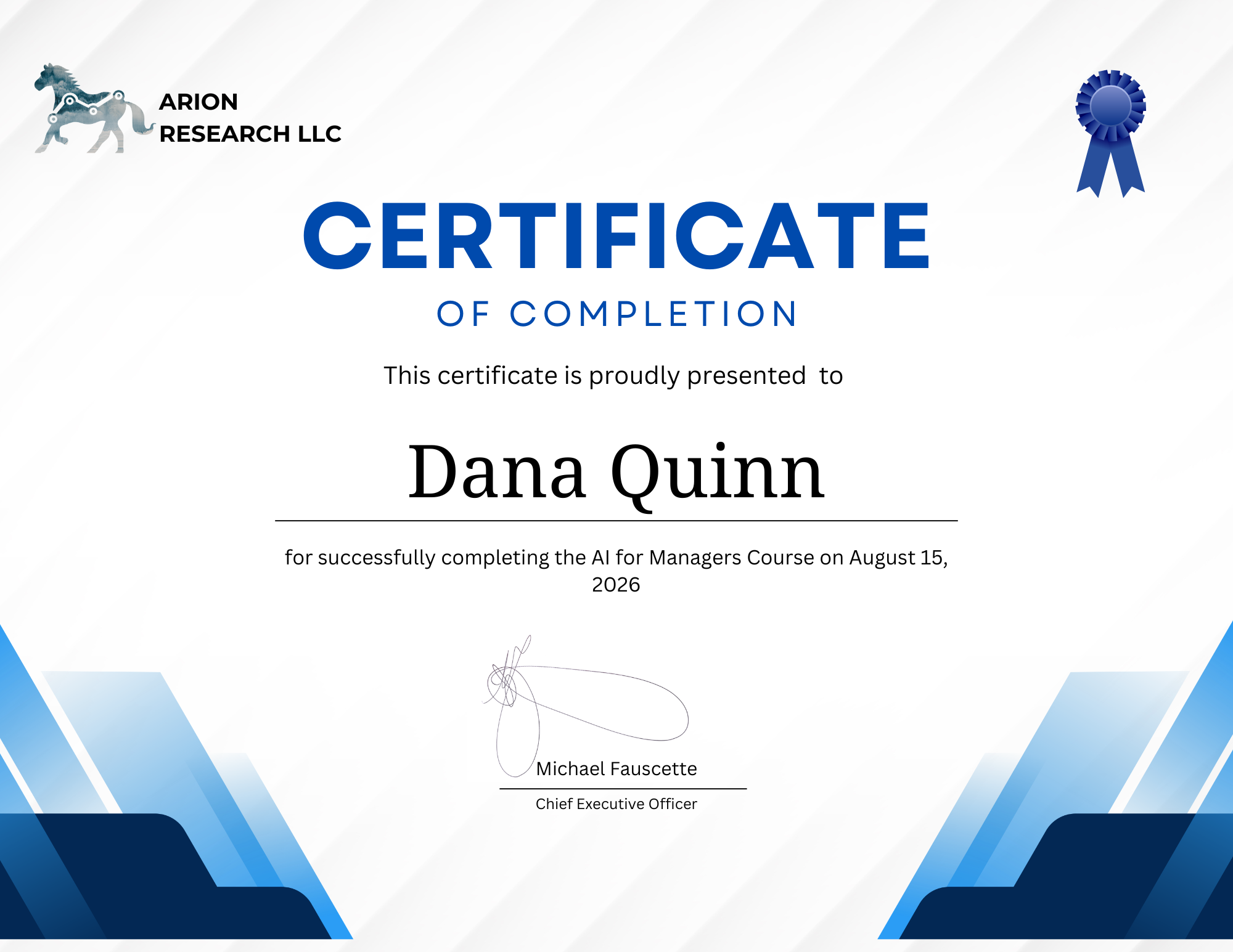
Certificate: a certificate of completion you can share on LinkedIn and with your organization
Price: $247
Training a team of managers? Team pricing is available. Use the contact form or the "Training a team? Let's talk" link to scope it out.
Why this course is different
It's vendor-neutral, practitioner-first, and taught by an analyst who has spent a career separating signal from hype. It's not a strategy course and it's not a coding bootcamp. The focus is what you do with your team this month.
Your instructor is Michael Fauscette, founder of Arion Research, a longtime technology industry analyst and executive, author of Building the Digital Workforce and The Complete Agentic AI Readiness Assessment, and host of podcasts and live shows on AI and digital business. Arion is independent: we don't sell AI tools and we're not paid to recommend them, so the guidance you get is unbiased.
Finish with a pilot plan for your team and the clear next step of running it. Enroll or contact us to scope team pricing.