

AI for Leaders: From Confusion to Confident Strategy
Every leader is under pressure to "do something" with AI. The hard part is not the technology, it is the noise around it. Vendors oversell, headlines overshoot, and competing definitions make it tough to tell what is real, what matters, and what is just hype.
Leaders fail in one of two ways: moving too slowly, or moving fast with no strategy and no guardrails. This course is the work of removing the confusion that causes both. It gives you a clear mental model of what today's AI can and cannot do, a prioritized set of use cases, the governance to move safely, and a draft roadmap you can act on. The course name is the promise: it disambiguates AI for the person who has to make the decisions.
Who it is for
Mid-market leaders and decision-makers: CEOs and owners, COOs, CFOs, CIOs and CDOs, and business-unit heads. If you set strategy, evaluate vendors, approve budgets, or guide teams through change, this is built for you. You do not need a technical background. Everything is taught in plain business language, because the goal is judgment, not code. There is no coding and no model math.
-
-
Introduction: The leader's AI mandate
Every mid-market leader is under pressure to do something with AI. The hard part of AI is not the technology. It is the noise around it. This course exists to remove that confusion so you can make good decisions. The name is the promise: it disambiguates AI for the person who has to decide.
Every mid-market leader is under pressure to do something with AI. The hard part of AI is not the technology. It is the noise around it. This course exists to remove that confusion so you can make good decisions. The name is the promise: it disambiguates AI for the person who has to decide.
-
-
-
Module 1: Understand, cutting through the AI hype
Before you decide anything about AI, you need a mental model. Not a technical one, a leader's one: simple enough to carry into a vendor meeting and sturdy enough to keep you from getting sold. This module gives you a clear picture of what today's AI is, so the rest of the course stands on solid ground.
Before you decide anything about AI, you need a mental model. Not a technical one, a leader's one: simple enough to carry into a vendor meeting and sturdy enough to keep you from getting sold. This module gives you a clear picture of what today's AI is, so the rest of the course stands on solid ground.
-
-
-
Module 2: Find value, spotting and prioritizing use cases
This module puts your mental model to work by answering the question that actually matters to a P&L: where, specifically, does AI create value in your business, this quarter and next? Every use case worth your time creates value in one of five ways: cost, speed, quality, capacity, or new capability.
This module puts your mental model to work by answering the question that actually matters to a P&L: where, specifically, does AI create value in your business, this quarter and next? Every use case worth your time creates value in one of five ways: cost, speed, quality, capacity, or new capability.
-
-
-
AI for Leaders: Govern, risk, policy, and responsible adoption
Most leaders hear 'governance' and picture a committee that slows everything down. Good governance is the opposite. It is what lets you move fast with confidence, because you already know where the risk sits and who is watching it. Governance removes the blindness, not the speed.
Most leaders hear 'governance' and picture a committee that slows everything down. Good governance is the opposite. It is what lets you move fast with confidence, because you already know where the risk sits and who is watching it. Governance removes the blindness, not the speed.
-
-
-
AI for Leaders: Workforce, people, adoption, and the digital workforce
Leaders pick good use cases and put reasonable guardrails in place, and the rollout still stalls, not because the AI tool failed, but because nobody on the team trusted it, understood it, or wanted to change how they worked. The barrier is rarely the technology. It's adoption and change.
Leaders pick good use cases and put reasonable guardrails in place, and the rollout still stalls, not because the AI tool failed, but because nobody on the team trusted it, understood it, or wanted to change how they worked. The barrier is rarely the technology. It's adoption and change.
-
-
-
AI for Leaders: Act, build your AI roadmap and lead it
You're not starting Module 5 from a blank sheet. Your glossary sharpened how you talk about AI. Your opportunity map gave you a ranked list of use cases. Your governance checklist gave you guardrails. Your readiness self-check gave you an honest score. This module doesn't ask for new analysis. It asks you to sequence what you already have into a plan you can act on Monday.
You're not starting Module 5 from a blank sheet. Your glossary sharpened how you talk about AI. Your opportunity map gave you a ranked list of use cases. Your governance checklist gave you guardrails. Your readiness self-check gave you an honest score. This module doesn't ask for new analysis. It asks you to sequence what you already have into a plan you can act on Monday.
-
What you will be able to do
By the end of the course you will be able to:
Separate what today's AI can and cannot do from the marketing claims, and speak the vocabulary that keeps you from getting sold
Spot and prioritize the highest-value AI use cases in your own business, using a clear value-versus-feasibility lens
Put the starter governance and acceptable-use guardrails in place that enable speed instead of blocking it
Lead the people side of AI: how a digital workforce and human teams divide work, and how to drive adoption without triggering fear
Read your organization's true readiness and find the gaps on your critical path
Build and sequence a practical, one-page AI roadmap, with the metrics to prove value to your board and team
What is inside
Five core modules and a short intro, a few hours of focused, self-paced learning. The course follows a single arc, from clarity to a plan you can act on. Each module pairs a clear explanation with a working template you complete using your own business.
Intro: The leader's AI mandate. Why now, the two ways leaders fail, and what you will walk away with. This is not a technical course. It is about judgment and decisions.

Module 1: Understand, cutting through the AI hype. A leader's mental model of AI: generative versus agentic, and what each is good and bad at. The digital workforce concept, what is real today versus what is still hype, and the vocabulary you need to ask good questions. Working tool: The Leader's AI Glossary. Your move: write your organization's current AI reality in three sentences.
Module 2: Find value, spotting and prioritizing use cases. Where AI creates value (cost, speed, quality, capacity, and new capability), a simple method to map opportunities across your functions, and how to prioritize with a value-versus-feasibility lens plus ROI and payback basics. Build versus buy versus partner at a decision-maker altitude. Working tool: AI Use-Case Opportunity Map. Your move: identify and rank your top five candidate use cases.
Module 3: Govern, risk, policy, and responsible adoption. The guardrails to put in place before scaling: data, security, privacy, IP, and accuracy and oversight. AI policy basics, the regulatory and ethics landscape in plain terms, and how to stay ahead of it without a legal team. Governance that enables speed rather than blocking it. Working tool: AI Governance and Acceptable-Use Checklist. Your move: flag your top three risk exposures and who owns each.
Module 4: Workforce, people, adoption, and the digital workforce. How agentic AI and human teams divide work and collaborate. The real barrier is rarely the tech, it is adoption and change, and what leaders must do about it: building literacy, the roles you need and do not need to hire, and communicating AI change without triggering fear. Working tool: AI and Change Readiness Self-Check. Your move: assess your organization's adoption readiness and gaps.
Module 5: Act, build your AI roadmap and lead it (capstone). Sequencing quick wins (30 days), medium initiatives (60 to 90 days), and foundations. Setting the metrics and KPIs that prove value, the leadership operating cadence to steer AI over time, and knowing when to bring in outside help versus build internally. Capstone deliverable: a one-page draft AI roadmap for your organization.
Format and logistics
Format: Self-paced online, five core modules plus a short intro
Time commitment: A few hours total, on your schedule
Working templates: Five reusable tools you complete as you go (glossary, opportunity map, governance checklist, readiness self-check, and roadmap canvas), yours to keep and reuse with your team
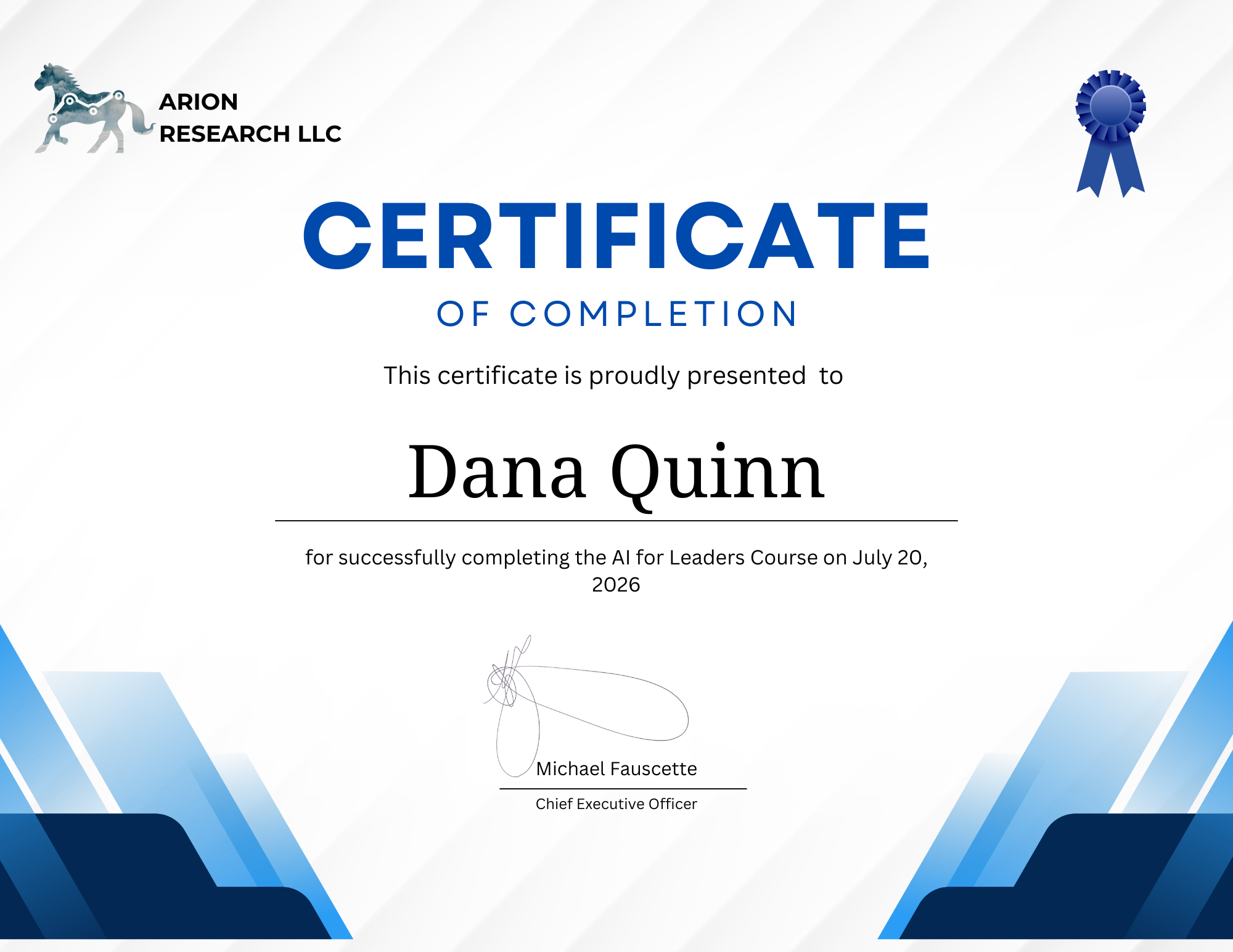
Certificate: a certificate of completion you can share on LinkedIn and with your organization
Price: Individual:$397; Team: $1500 (up to 5 Person Team); Enterprise / Larger Teams: Contact Us for Details
Want to train your whole leadership team? We run private cohorts tailored to your industry and your specific use cases, so the examples and the plan come straight from your business.
Why this course is different
It is vendor-neutral, business-first, and taught by an analyst who has spent a career separating signal from hype. It is not a product pitch and it is not a coding bootcamp. The focus is the decisions you have to make and the outcomes you are responsible for.
Your instructor is Michael Fauscette, founder of Arion Research, a longtime technology industry analyst and executive, author of Building the Digital Workforce and The Complete Agentic AI Readiness Assessment, and host of podcasts and live shows on AI and digital business. Arion is independent: we do not sell AI tools and we are not paid to recommend them, so the guidance you get is unbiased.